 Omrdon Technology
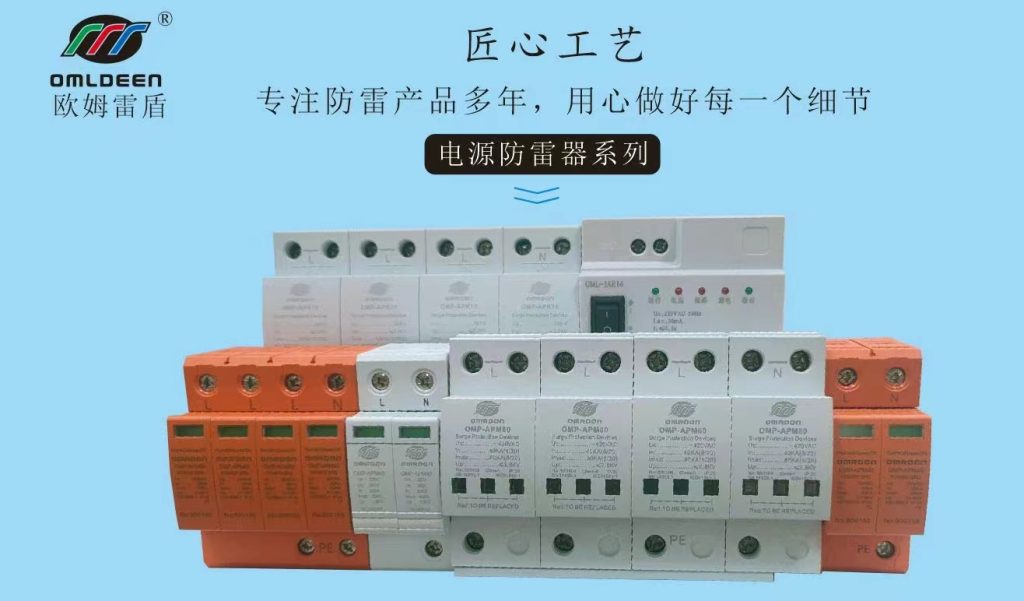
In accordance with GB18802.1 three-level lightning protection principle, lightning surge protector, as a key device to protect the safety of electrical equipment, its installation location and functional level have a clear division. First, second and third level protectors each bear different protective duties, together build a full range of electrical safety defenses.
In the building into the cabinet to choose a relatively large throughput capacity of T1-level power lightning protector, waveform 10/350us, impact discharge current Iimp for 12.5kA ~ 50kA or choose the waveform 8/20us, but the maximum discharge current for Imax 80 kA, In: 40 kA or more products; and then in the subordinate areas of the distribution box at the installation of the second level of power lightning protection, waveform 8/20us, maximum discharge current for Imax 40 kA, and finally in the front of the equipment to install three-level power lightning protection, waveform 8/20us, maximum discharge current of 20 kA. 20us, the maximum discharge current is Imax for 40 kA, and finally install the three-level power supply lightning arrester at the front of the equipment, with waveform 8/20us and maximum discharge current of 20 kA.
- Primary protection: external lines of defense
Class I lightning surge protectors are usually installed at the entrance of electrical equipment, i.e. the beginning of the power line. Choose a T1 level power supply lightning protector with large relative throughput capacity, waveform 10/350us and inrush discharge current Iimp of 12.5kA~50kA or choose a product with waveform 8/20us but maximum discharge current Imax of 80 kA, In: 40 kA or more. Its main function is to protect against lightning strikes or surge voltages from external power sources, preventing these powerful currents from causing direct harm to electrical equipment. With its sturdy line of defense, the primary protector provides initial safety for the entire electrical system.
- Secondary protection: internal reinforcement
The secondary lightning surge protector goes further into the interior of the electrical equipment and is installed near the lines or critical equipment. With a selected waveform of 8/20us and a maximum discharge current of Imax of 40kA or 60KA, its task is to prevent internal cables, data lines, etc. from being damaged by external lightning strikes or surge voltages. Due to the more critical installation location, the installation of secondary protectors usually requires a higher level of skill and delicate handling.
- Three levels of protection: precision guarding
A three-stage lightning surge protector is the final barrier to electrical safety protection and is installed directly inside the circuitry of electrical equipment, such as circuit boards or critical electronic components. Its role is to prevent internal lightning strikes and surge voltages caused by circuit operating errors, overcurrent and other reasons for equipment damage. Therefore, a three-stage surge protector with a waveform of 8/20us and a maximum discharge current of 20kA is selected. The installation of the three-stage protector requires a higher level of technical and specialized knowledge, as it needs to be mounted precisely on the circuit board.
The working principle of the lightning surge protector is based on its unique current guidance and dissipation mechanism. When electrical equipment is struck by lightning or surge voltage, the protector is able to respond quickly by directing these powerful currents to the grounding electrode and dissipating them through a specific dissipation mechanism, thus preventing the current from causing direct damage to the electrical equipment.