Product selection and configuration:
Q1:What is the difference between “2P” and “3P” surge arresters when selecting and installing? How to choose?
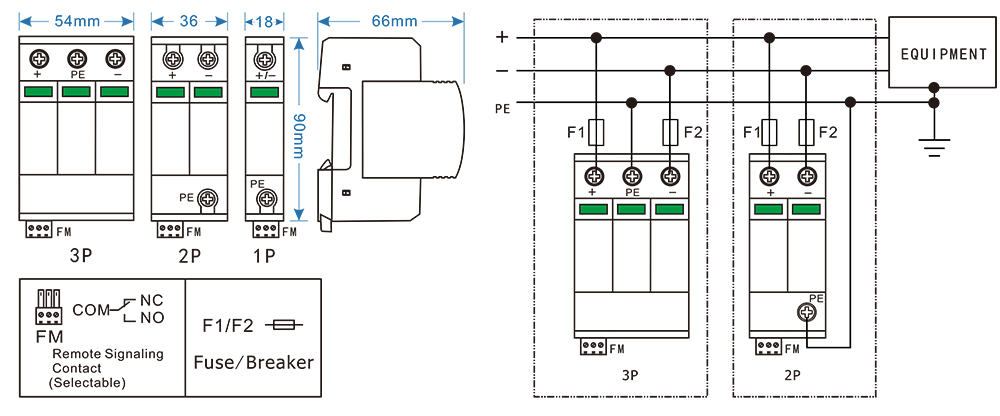
A: The “P” here stands for “Pole”, which refers to the number of protection modules inside the lightning protector and the way of wiring, the choice of which depends entirely onElectrical architecture of PV DC systemsThe
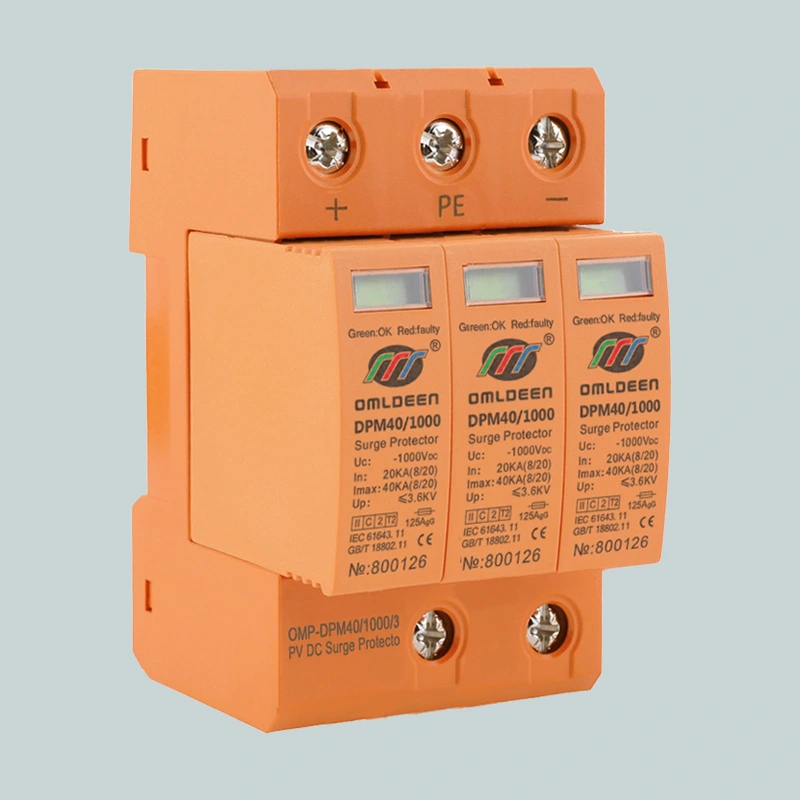
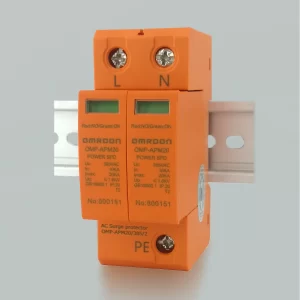
2P Surge Protector (unipolar to ground protection)::
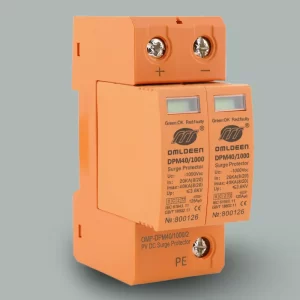
framework: There are two internal lightning protection modules, which are normally used to protect the “positive (+) to earth (PE)” and “negative (-) to earth (PE)” circuits.
Applicable systems: This is the most common PV system configuration forDC systems where neither the positive nor the negative terminal is directly grounded(i.e., suspension system). All OMP-DPM40/***/2 series models listed on this website and in the manuals.All belong to this type of 2P structureThe terminals are “+”, “-” and “PE”. The terminals are "+", "-" and "PE".
3P Lightning Protector (Bipolar to ground and inter-pole protection)::
framework: There are three internal lightning protection modules. In addition to the “positive to ground” and “negative to ground” protection mentioned above, theAddition of a protection module “between positive and negative (+/-)”.The
Applicable systems: This applies mainly to the following two special scenarios:
Bipolar photovoltaic system: The system neutral may be grounded or there is a high risk of a potential difference between the positive and negative poles of the system.
Systems with special requirements for protection against inter-pole overpressure: When it is necessary to guard against abnormal high voltages that may occur between the positive and negative terminals (e.g., caused by internal system malfunctions).
connect a wireThe terminals are usually “+”, “-” and “PE” and have integrated inter-polar protection.
How to choose?
For most conventional PV plants(positive and negative terminals are suspended when the components are connected in series), using a standard2P Surge Protector(i.e., this product) can satisfy the need for “common mode” (to ground) protection.
If you are unsure of the system architecture, or if the system designer explicitly requires “differential mode” (inter-polar) overvoltage suppression, select the3P Surge ProtectorThe
Core principles: Always refer to the electrical design drawings of the PV system, orConsulting System Integrator/Electrical Engineerto determine the desired lightning arrester protection mode.
Installation Differences::
connect a wire2P lightning protector is connected to “+”, “-” and “PE” wires; 3P lightning protector is also connected to these three wires, but its internal circuit already contains inter-pole protection, no need for additional external wiring. The 3P lightning protector also connects to these three wires, but its internal circuit already contains inter-pole protection, so no additional external wiring is required.
Selection ConfirmationWhen ordering, please specify to the supplier that you require a “2P” or “3P” configuration. We can provide different configurations of lightning protection solutions.
Q2: How to choose the right type of lightning protector for my PV plant?
A: The core basis is your system'sMaximum continuous operating voltage (Uc). The Uc value of the selected lightning protector must be higher than the highest possible DC voltage of the system (the temperature coefficient of the module open-circuit voltage and the maximum voltage of the PV array need to be taken into account). For example, if the maximum system voltage is about 900V, a model with Uc ≥ 1000V should be selected (e.g. OMP-DPM40/1000). It is recommended to consult a professional electrical engineer for accounting.
Q3: What is the significance of “Voltage Protection Level (Up)” for different models?
A: The Up value represents the residual voltage at both ends of the lightning protector when it is discharging lightning current. The valuelower, meaning that the lower the overvoltage transmitted to the back-end device (e.g. inverter), the better the protection. On the premise of meeting the Uc requirement, it is recommended to choose a product with a lower Up value to provide finer protection.
Q4:Is this lightning protector suitable for string inverter system?
A: Fully applicable. Whether it is centralized, string or household distributed PV system, as long as the DC side voltage of the system is within the range of the lightning protector Uc, it can be used. Usually installed at the output of the convergence box or the DC input of the inverter.
Installation and wiring:
Q5: What are the specific requirements for the specification of the connecting wires during installation?
A: The required access conductor (L/N) cross-section is16-25mm²and copper core wire must be used. The conductors should be as short and straight as possible to minimize the effect of lead inductance on the protection effect. The grounding wire (PE) must use≥16mm²of copper-core wire.
Q6: Any suggestions for installation location? Can it be installed outdoors?
A: It is recommended to prioritize the installation ofIndoor or in a waterproof distribution box. Although the product is IP20 rated for protection against small amounts of dust, thewaterproof. If it must be installed outdoors, it must be equipped with a special waterproof case with a protection level of not less than IP54.
Q7: Is it necessary to add a protection device to the front end of the lightning arrester? How should it be selected?
A: Installation is highly recommended. The front end should be connected in series with a matched DC-specific fuse or circuit breaker (back-up protection) with a rated current of 100A is usually recommended (depending on the system current). This prevents persistent faults or fires caused by deteriorating short circuits in the surge arrestor and facilitates isolation for maintenance.
Q8:How to get the remote alarm signal (telecommunication)?
A: For models that support telecommunication, the communication terminals (typically a pair of normally open/closed dry contacts) can be wired into your existingEnvironmental monitoring system, SCADA system or intelligent convergence boxof the alarm input port. When the lightning arrester fails (window turns red), the contact status changes, thus triggering the remote alarm. For wiring, please refer to the terminal diagram of the specific model.
Q9: Can I install it myself?
A: We do not recommend installation by non-professionals. Correct installation and grounding of the lightning protector is the key to its effectiveness and safety, and must be carried out by theQualified electricianand operated by professionals with knowledge of lightning protection systems to ensure compliance with relevant national safety codes.
Operation, maintenance and fault determination:
Q10: Besides looking at the window color, how can I tell if the lightning protector has failed?
A: 1. Window turns redIt is the most intuitive indication of failure. 2. It can be used during periodic inspections.multimeterMeasure the resistance of its terminals in the power-off state. If it shows a near-short circuit (very low resistance) or an open circuit (infinite resistance), both of which may indicate that the internal components have been damaged.3. If the system has been subjected to a recent lightning strike or after an abnormal overvoltage, it is recommended that it be tested even if the window is still green.
Q11: What is the normal service life of a lightning protector?
A: Surge arresters do not have a fixed service life, their life depends on the number and intensity of overvoltages suffered. In a normal environment without lightning strikes, its internal components will be slowly aging, the general recommendedAfter 3-5 years of useorAfter accumulating a number of significant lightning strikes, even if no fault is indicated, professional testing or preventive replacement should be considered.
Q12: Do I have to replace the lightning protector window immediately after it turns red? Can the system continue to operate?
A: Must be replaced immediately. A reddened window indicates that its internal protection module has been damaged and has lost its surge protection. At this point, while the current path may still exist (some models), the system is fully exposed to the risk of a lightning strike, theContinued long-term operation is strictly prohibited, replacement should be arranged as soon as possible.
Q13: How do I perform routine maintenance?
A: 1. visual inspection: Check the alarm window color and housing for physical damage and burn marks every quarter or before and after the thunderstorm season. 2. Electrical connection check: Check terminals for looseness and corrosion once a year. 3. Ground check: Measure grounding resistance once a year to ensure ≤ 4Ω. 4. record (in sports etc): Record each inspection and lightning strike event.
After-sales service and others:
Q14:Does the product have a warranty? How long is the warranty period?
A: OMROON products are supplied from the date of shipment.third yearThe free quality guarantee. Under normal installation and use conditions, we will provide repair or replacement service if there is any problem with the quality or manufacturing process. Please refer to the accompanying Product Quality Warranty for specific terms.
Contact Us
 Omrdon Technology